

You may have seen this little flower beneath your feet in Barcelona and later recognized it on a pendant. The Barcelona Flower takes its name from a motif on the city’s pavement: a geometric flower with four petals around a circular center.
To understand its history, it is helpful to distinguish the flower *panot* (paver) from Gaudí's hexagonal mosaic. Both are part of the Barcelona landscape, but they have different designs and trajectories.
What is the Barcelona Flower and what does "panot" mean
A panot is a tile used to pave sidewalks. The flower is one of its designs; the term does not refer exclusively to it. In the floral model, the lines form a central circle surrounded by four rounded shapes, so that the whole is recognized as a four-petaled flower.
In a piece of jewelry, only that drawing may be kept, without the square of the tile. That is why a pendant with the Barcelona Flower does not have to look like a miniature tile: the motif can become a cut-out silhouette, as in the pieces we show here.
Barcelona Flower and Gaudí panot: how to distinguish them
The four-petaled flower is not Gaudí's hexagonal mosaic. Escofet, the manufacturer of the design, dates Antoni Gaudí's original mosaic to 1904. It was designed for interiors, and its 1997 outdoor adaptation was used on Passeig de Gràcia.
Flower panot
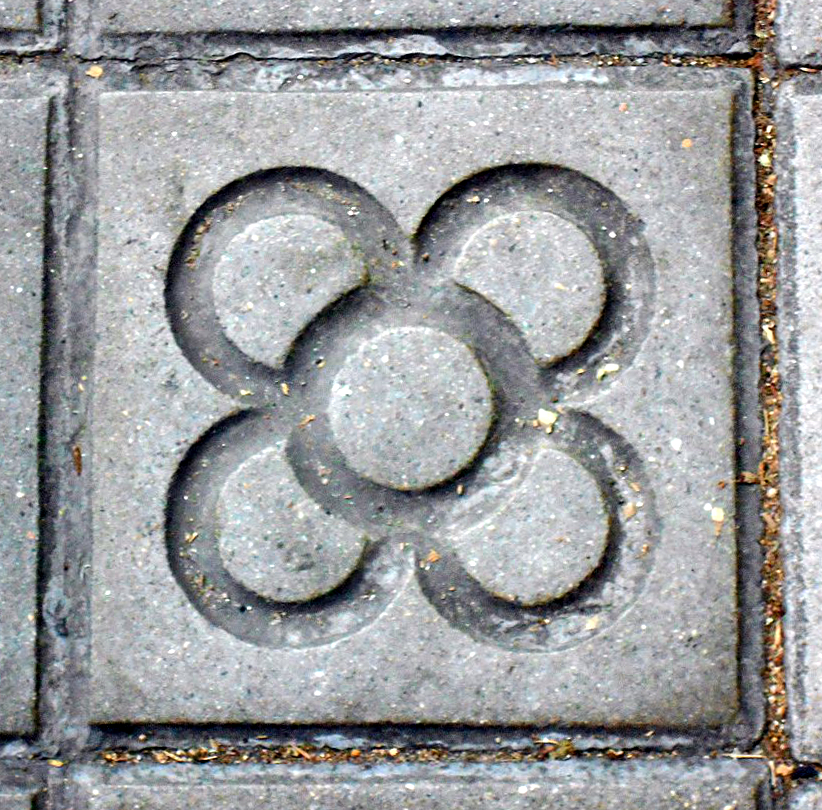
Square tile · four petals. A circular center surrounded by rounded shapes. In jewelry, the flower is usually kept without the tile frame.
Gaudí panot

Hexagonal tile · marine motifs. Starfish, ammonite, and seaweed: the figures are completed when combining several pieces. It is the design by Antoni Gaudí manufactured by Escofet.
Why this flower is linked to Barcelona
Its history belongs to the transformation of the Eixample sidewalks at the beginning of the 20th century. The university publication Barcelona a ras de suelo explains the standardization of the panots and the 1907 contest, from which five models emerged that helped define the city's urban image.
The repeated presence of the flower on the ground helps explain its current recognition. It is an everyday detail that can enter the memory of anyone walking through Barcelona, even if they do not know its name.
Who designed the flower panot?
One should be cautious about attributing it to Josep Puig i Cadafalch. The research collected in that publication distinguishes the pavement of Casa Amatller, made of stone with a carved floral motif, from the cement panot of the sidewalks. The resemblance is not enough to attribute the urban design to him with certainty.
What it can mean to wear the Barcelona Flower
In jewelry, its most direct interpretation is a connection with Barcelona. From there, each person can give it their own meaning: remembering a neighborhood, some years of study, a friendship, or a shared walk. The specific memory is provided by the person wearing the piece.
You don't need to have been born in the city, either. You might like it for its geometric layout or because Barcelona is part of your history.
From the sidewalk drawing to the pendant
Adapting it to a piece of jewelry changes the scale and the medium. On the Cotigo Barcelona Flower Pendant, the motif appears as a cut-out and is attached to a chain via a ring. The center and the four petals can be distinguished, without the square outline of the tile.

The Cotigo pendant is made of stainless steel and is available in Gold and Silver finishes.
How to choose between gold and silver
Start with the jewelry you already wear. If gold tones predominate, that finish can be easily integrated; if you usually wear silver tones, the other option maintains that continuity. You can also mix them to add variety to your look.
To combine it with other chains, take into account where you want the pendant to hang. If you need a specific measurement, check it on the product page or with Cotigo before choosing.
A gift for someone who recognizes Barcelona in its details
This flower can have meaning for someone who pays attention to the city's design: it transforms a drawing that usually stays underfoot into a visible piece. If you share a walk or a favorite neighborhood, that everyday detail can make the gift personal without needing a long dedication.
To compare other symbols linked to a place, check the guide to regional jewelry for gifting identity and origin.


0 comments